
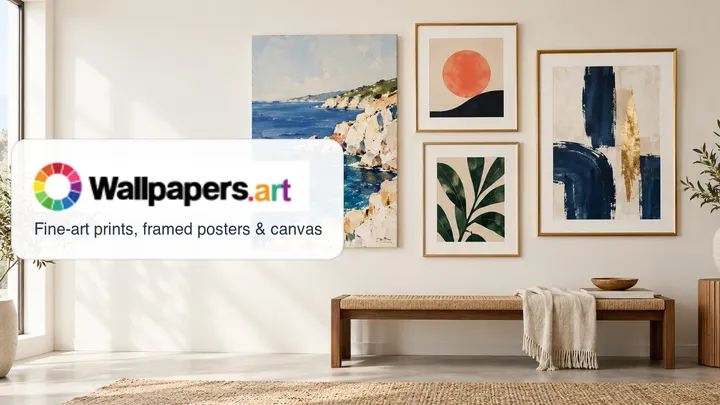
Finding an image you like is easy. Knowing whether that image will work on your wall is another matter entirely. That gap—between discovery and confident purchase—is why we built Wallpapers.art.
Finding artwork online can still leave practical questions unanswered: whether the crop suits the chosen size, whether the source holds enough detail, and how a screen preview relates to a physical print. We wanted to close that gap, step by step.
Discovery without commitment
We began with a simple observation: browsing images should not require you to imagine the final object. Our product preview offers three views: Original, Print crop and In a room. Original shows the uncropped source composition as the creator intended. Print crop shows exactly what will be sent to print, locked to the aspect ratio you have chosen. In a room places the work in a domestic setting so you can judge scale and proportion before you decide.
This matters because a fixed print ratio can remove content from an original with a different ratio. A square crop of a panoramic photograph, for example, will lose the edges. Seeing that loss before you order is honest. It lets you decide whether the crop works for you, or whether you would prefer a different size that preserves more of the image.
Crop control that follows your choice
Even with a locked aspect ratio, you should be able to decide which part of the image appears in the final print. Our crop tool lets you adjust the framing while the required ratio remains fixed. The saved crop follows the cart and the order. There is no separate cropping step after checkout, and no surprise when the print arrives.
We do not offer every size for every artwork. Only sizes that pass our source-file, crop and print-readiness checks are made available. If the original file lacks the pixel dimensions to support a large print at a reasonable resolution, that size will not appear as an option. This is not a limitation; it is a safeguard.
Print-readiness and resolution
Printed image resolution is measured in pixels per printed inch (PPI). Pixel dimensions are the total pixels in the file; changing the print size without resampling changes the effective PPI. A 300 pixels-per-inch (PPI) target is commonly cited for high-quality prints at normal viewing distance, but we do not promise that one number guarantees quality. The relationship between pixel dimensions, print size and viewing distance is more nuanced than a single rule.
Our system checks the source file against the requested print size and flags any concerns before you order. You can see whether the file supports the size you want, and you can make an informed decision. If the file is marginal, we tell you. If it is insufficient, we do not offer that size.
What we offer today
Customers currently choose between fine art print, framed print or canvas, subject to artwork and size eligibility. We do not name our production suppliers, and we do not claim a specific archival rating. What we can say is that the materials and environment in which a print is kept affect its preservation. The Library of Congress recommends clean, dry handling, avoiding contact with the image area, limiting light exposure and avoiding direct adhesives. The Smithsonian adds that light can fade and chemically deteriorate paper and photographs, while unstable humidity can damage paper-based objects. These are factors you control after purchase, and we encourage you to consider them.
Our collection
Today our catalogue includes selected AI-generated works and historical open-access art. We chose these categories deliberately. AI work offers compositions that do not exist in the physical world; historical open-access art brings centuries of visual culture into print at sizes that respect the original. In the future we will add work from independent creators, subject to the same print-readiness checks that apply to everything else.
We do not believe that more choice is always better. A smaller, vetted collection, where every piece has been reviewed for print suitability, is more useful than a vast library where most files will never produce a satisfactory print at the sizes offered.
Hanging your print
Once your print arrives, hanging it at a sensible height makes a real difference. A gallery-standard starting point places the visual centre of a work around 57–60 inches (145–152 cm) from the floor. This is a starting point, not an absolute rule. Furniture, seated viewing and room proportions can justify adjustment. Trust your eye, but use the standard as a reference.
We built Wallpapers.art because we wanted a place where the path from discovery to wall was clear, honest and free of guesswork. The previews show you what you will get. The crop control lets you decide the framing. The print-readiness checks protect you from ordering a size the file cannot support. And the collection is curated for print, not for screen.
That is why we built it.